

The war with Iran has had enormous consequences, especially on countries that import fossil fuels, mostly oil and natural gas. The reduction of about eleven million barrels of oil per day from the Gulf region has hit the economies of many nations depending on these fossil fuels hard. Globally we consume about one hundred million barrels of oil per day.
“The vase is broken, the damage is done,” and “it will be very difficult to put the pieces back together,” per International Energy Agency [IEA] Executive Director Fatih Birol.
The whole global supply chain as a result is in disarray.
One example of many is Sri Lanka. They have had to shut down their economy one day a week due to the shortage of energy. And they are not alone. Many other Asian nations are scrambling as well to keep their people employed and economies going.
The positive aspect to this oil supply disruption is that many governments are reviewing their renewable energy options [wind, solar, hydro, geothermal, nuclear] to insulate their economies from war and disruptions of this type. Early indications are that many countries are planning to accelerate and expand their move to renewables. They cannot depend on “business as usual.”
An unintended consequence of this war is hastening the transition away from fossil fuels to renewables and reducing the emissions of carbon dioxide, the most common greenhouse gas [GHG].
This is good news for Earth’s changing climate.
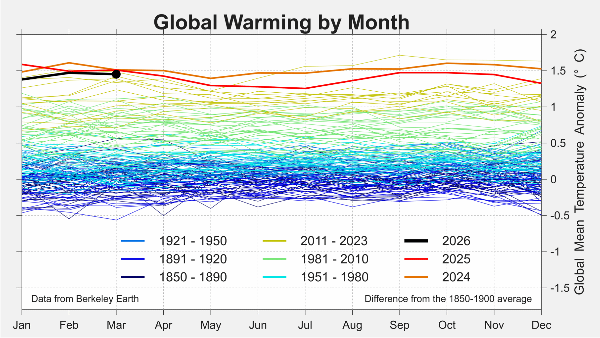
Look at the series of different colored horizontal lines in the image titled “Global Warming by Month” from Berkeley Earth, a not-for- profit climate research group in CA. While March 2026 was cold and unpleasant here in the North Country, overall, it was the fourth warmest on record Globally, with the climate record going back well over 150 years. All of the blue, cooler months of years past are at the bottom of the chart with the warmer months [yellow, orange, red] slowly rising up until we see the black dot near the very top for March 2026.
This movement towards renewables could not come quick enough. The chart from Climate Central titled “NEW YORK CITY, APRIL WARMING” shows the relentless warming of our climate as demonstrated in this city over the past 56 years. There are warmer years [spikes above the dark line] and cooler years[spikes below the dark line]but the overall average is +2.3 degrees.
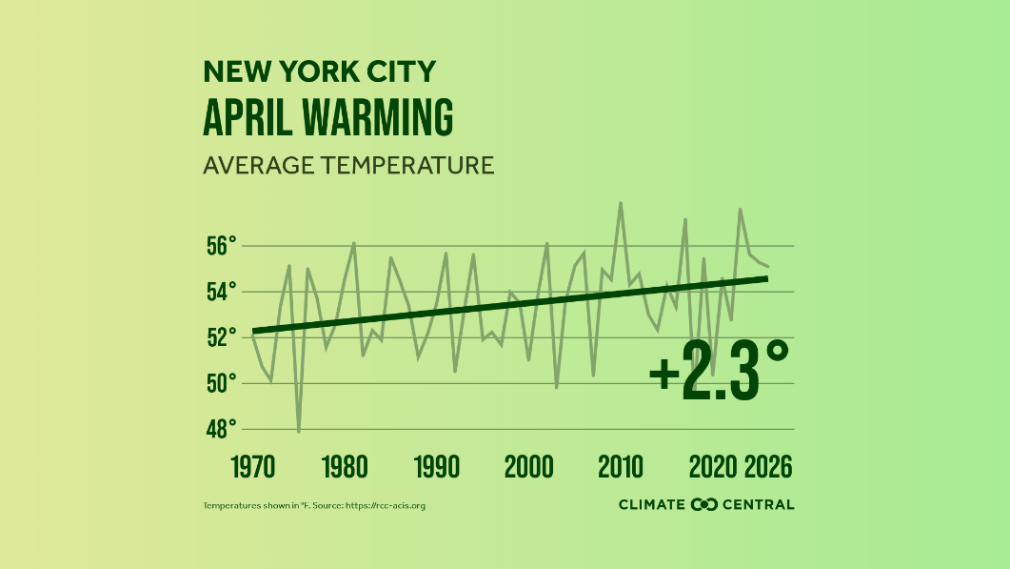
And it is not just NYC. 192 cities across the U. S. saw temperatures of 3.4 degrees Fahrenheit above their normal average readings for April.
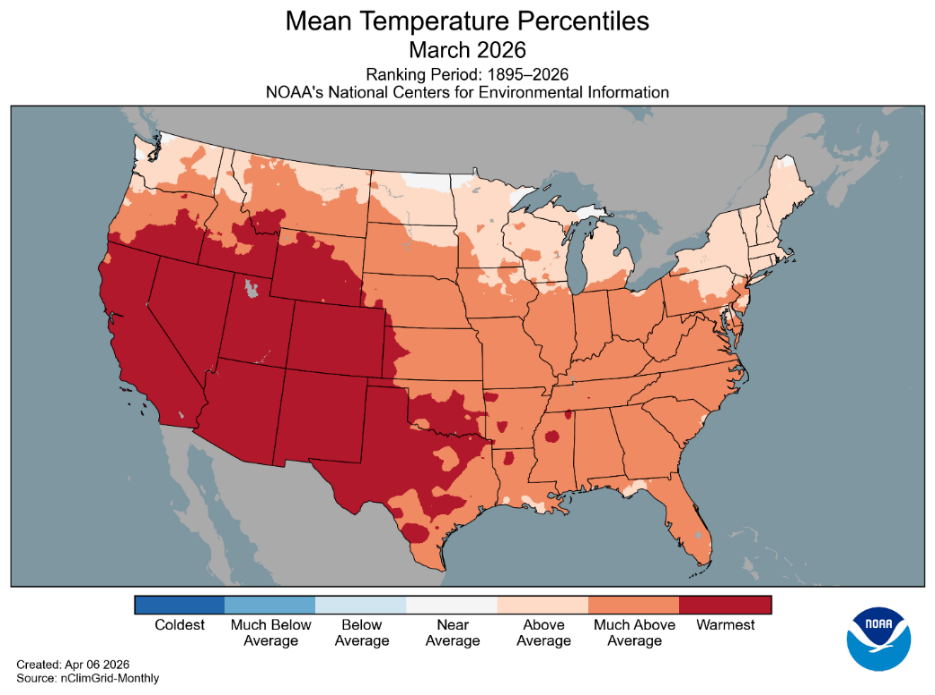
The image [titled “Mean Temperature Percentiles”] of the continental U.S. supplied by NOAA [National Oceanographic and Atmospheric Administration] for the month of March 2026 is remarkable. Almost the entire country shows “Above Average” to “Much Above Average” to “Warmest” for that 130-year period. The southwest in particular set many high temperature records.
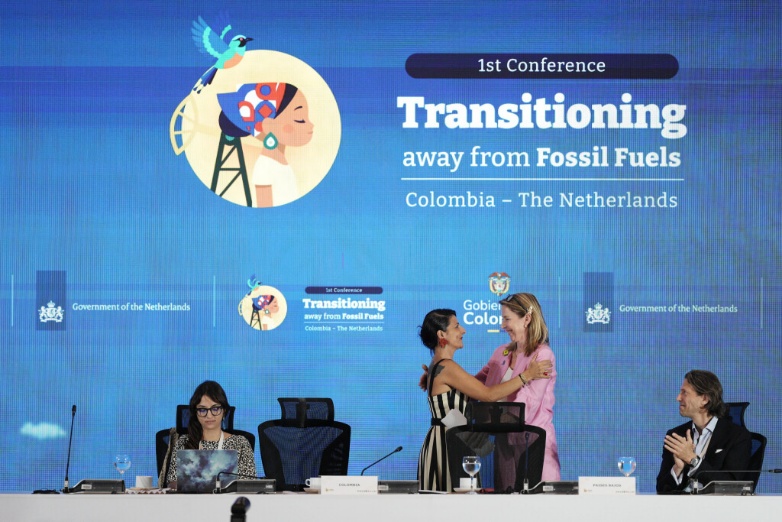
And now, we have a new player in the energy transition that is underway. See photo of “1st Conference,” “Transitioning away from Fossil Fuels”, that was held in Columbia, 28-29 April 2026 [TAFF 1]. With disappointment at the progress of the UN Council of Parties [COP] and opposition by Saudi Arabia, Russia the U. S. and other oil producing countries to efforts to transition away from fossil fuels a new organization has started. Over fifty countries participated but the U. S. was not invited and did not attend.
Chaired by the Netherlands Minister of Climate Policy and Green Growth, Stientje van Veldhoven, second from right in the photo, and by Director, National Environmental Agency, Irene Velez Torres of Columbia, third from right, at the conference. [Photo of podium members by IISD/ENB/Ivan Valencia],
A full summary of the actions taken and in a report is available at Earth Negotiations Bulletin, 5/4/26. Perhaps now we will see more progress in this renewable energy transition by a sizable number of Earth’s citizens and countries.
TAFF 2 will take place in Tuvalu in 2027.
Bits and pieces:
—“Reporters Without Borders warns that press freedom has fallen to its lowest level since” measurements began in 2002.“The U. S. was ranked 17th in 2002 and today it stands at 64th. Accurate information about the transition to renewables and many other issues may be harder to get.
—“The International Energy Agency [IEA] has warned of an unprecedented energy shock” and that “the world is grappling with the largest disruption to oil supplies in history.” EuroNews. com/2026/4/14.
—“OPEC will be less powerful without one of its leading members” with the announcement that the United Arab Emirates is leaving after more than 50 years of membership. The full impact is yet to be determined. NYTimes, Thursday, April 30, 2026.
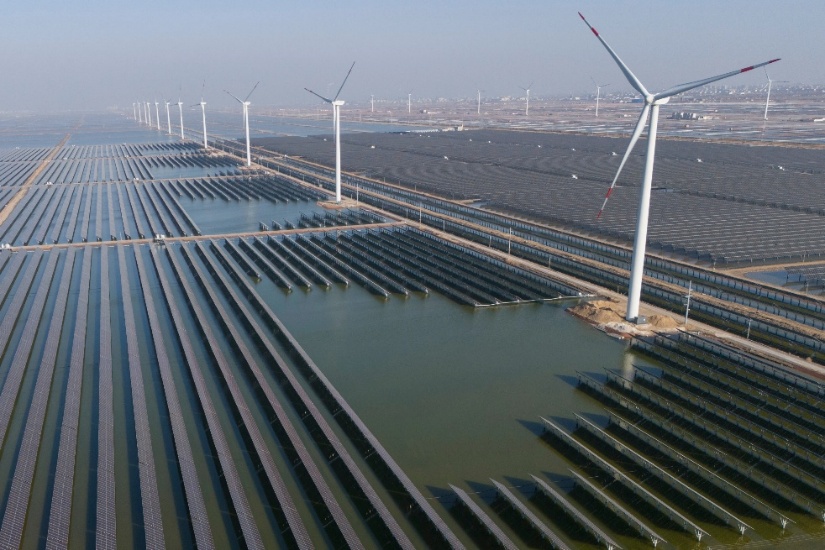
— The “Electrotech Revolution Is Here – And Booming” according to The Energy Mix, June 18, 2025. With lots of bad news on the energy transition, “those despairing trends leave out the many instances of progress: global clean energy investment has doubled fossil fuel spending … and in China“ the world’s first electrostate, “half of all new cars sold are electric.” See photo here of a huge renewables installation with wind turbines combined with a solar farm in eastern China’s Shandong province on March 22, 2024. (AP Photo/Ng Han Guan, File).
— “Power consumption in the U. S. hits another record high” for the second year in a row according to the Energy Information Agency [EIA]. NYTimes, April 8, 2026.
— IEA says in its report for 2025 that the world has entered the “Age of Electricity.” CleanTechnica 4/25/26.
And so it goes.
The scientific career of Raymond N. Johnson, Ph.D., spanned 30 years in research and development as an organic/analytical chemist. He is currently founder and director of the Institute of Climate Studies USA (www.ICSUSA.org). Climate Science is published monthly.
Sources
Images: IISD/ENB/Ivan Valencia.