

There are some newer terms entering the vocabulary when weather and climate change are being discussed. One of these terms is “Flash Drought.” According to Wikipedia this is “a type of drought characterized by its rapid onset, intensification, and severity over a relatively short timescale, usually within a few days or weeks.” These have gained “increasing attention from researchers and policymakers because of their impact on agriculture, and water resources.”
According to NOAA [National Oceanographic and Atmospheric Administration] website, Climate.gov, flash droughts pose challenges for agriculture [food production], ecosystems and infrastructure. The Climate Prediction Center [National Weather Service] states that, for 2025, the Northeast will see above average precipitation. Indeed, rainfall in Vermont and parts of northeastern NY saw very heavy rainfall events in May and early June. Leaf growth and vegetation made the area look very green and lush. Then rainfall virtually stopped.
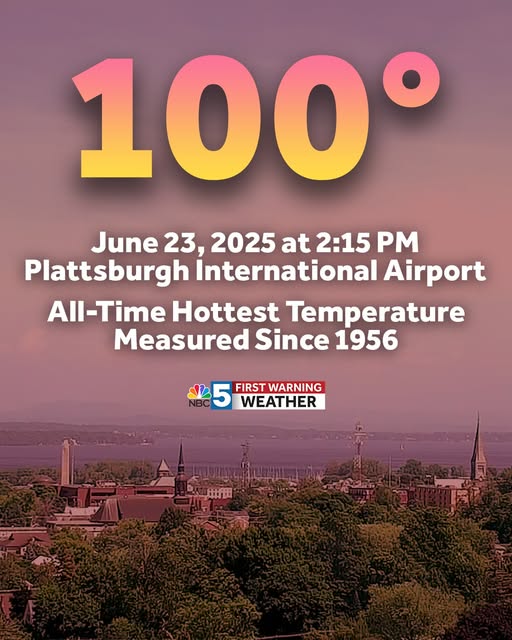
This was followed by a heat wave with Plattsburgh hitting 100 degrees F in late June, tying a record, and with many days since in the 80’sand 90’s. This heat reduces soil moisture, increases evaporation and is the subject of publications in Water Resources Research. This research has developed a “flash drought intensity index” to better characterize these short-term events.
And then we have “Heat Domes.” According to William Gallus, a professor of atmospheric science at Iowa State University, a heat dome happens when warm air is trapped over an area due to a persistent high-pressure system. It can last for days or weeks and can cover large areas over several states. On July 23, 2025, Grist estimated that about 160 million Americans would be impacted by the current heat dome moving slowly across the US.
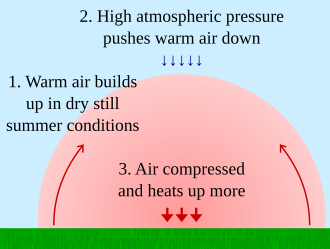
See the illustration from Wikipedia that details the 3 main processes that can cause this event; 1 Warm air builds up in dry still summer conditions; 2. High atmospheric pressure pushes warm air down; and, 3. Air compressed and heats up more. And they can be deadly.

Note the horizontal bar chart labeled, “Climate change drove a huge surge in heat deaths across 12 European cities.” Source: Imperial College London Grantham Institute.
Each bar chart has two colors; the dark blue starting from the left is “Deaths attributed to climate change” and the following lighter blue portion is labeled, “Non-climate deaths.” It covers the period from June 23 to July 2, 2025.
This data presentation is from a new process that is called, “attribution” studies, where scientists have access to death data for a particular day and can get number of deaths and the range of deaths for that day, over a period of many years. Then statistical analysis is used to estimate the number of excess deaths for that day.
The numbers are startling.
Heat waves are killing us, by the thousands.
Now the World Court in The Hague, Netherlands has stepped in. The IJC [International Court of Justice] has issued an advisory opinion “on states ’ legal obligations with regard to climate change and human rights.” It took a “two-hour reading of the unprecedented opinion.” “The courts top judge made clear that states can be held to account if they damage the Earth’s climate – and people’s rights – by allowing the ongoing production and use of fossil fuels.” [Climate Home News, July 25, 2025].
According to Sebastien Duyck, “an attorney with the Center For International Environmental Law,” that this “opens the door for further legal claims and reshapes what is now considered legally possible, actionable, and ultimately enforceable.”
In additional news Norway has set a tough act to follow as they continue to reduce their carbon emissions. With an enlightened government and policies to match, June 2025 was a great month for electric vehicles [EVs]. The number of newly registered EV passenger auto registrations reached 97.7% of the total for all new vehicle registrations. See circular chart titled, “June 2025 Norway Passenger Auto Registrations ’ prepared by Max Holland.

And then we have an electric airplane courtesy of Beta Technologies in Burlington Vermont. It has been undergoing tests for the military and for short flights for commercial purposes.

The Beta’s CX 300 electric aircraft travelled from New York to California and back, flying in VFR [Visual Flight Rules], IFR [Instrument Flight Rules], day, and night conditions. [Photo Courtesy: Beta Technologies].
There is always good news to share along with the crazy going-ons.
And so it goes.
The scientific career of Raymond N. Johnson, Ph.D., spanned 30 years in research and development as an organic/analytical chemist. He is currently founder and director of the Institute of Climate Studies USA (www.ICSUSA.org). Climate Science is published monthly.
Sources
- National Weather Service
- Climate Home News, 25 July 2025
- William Gallus
- Sebastien Duyck
- International Court of Justice
- National Oceanographic and Atmospheric Administration
Images: Beta Technologies.