
Renewables and Electrification: Still Going Strong Every where
We need perspective these days and there is a lot happening around the world. Let’stake a look at what is happening elsewhere.
As much as the White House would like to kill renewables, the momentum in that direction is very much alive in other parts of the world as well as here.
Please note the first illustration titled, “Pockets of the Future.” It really is apiece of good news. Michael Barnard has put together a paper, and given talk sin Canada, which has amazing breadth and depth. The entire presentation, some 15 pages long, with another 14 pages of Q+A, can be accessed in CleanTechnica, 3/4/26.
The author looks at several technological advances globally and then asks three questions.
Will it work?
Will it compete?
Will humans accept it?
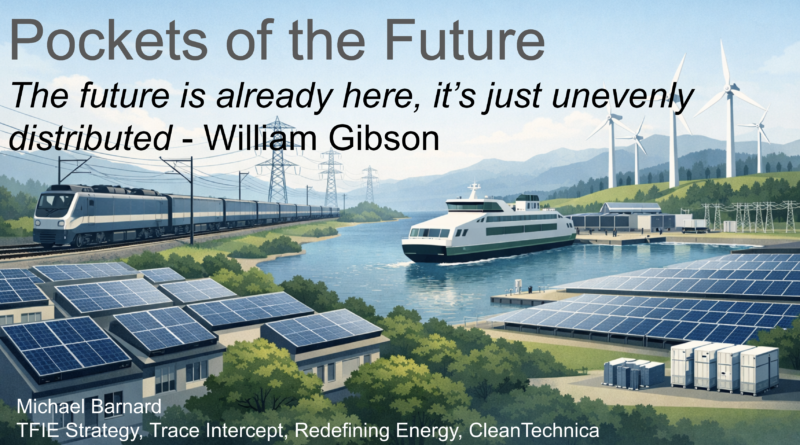
Slide from author’s Pockets of the Future presentation
Mr. Barnard does his homework and discusses electrification of the major parts of the global economy and provides the reasons for the answers to his three questions as, … YES, YES and YES.
As William Gibson states, “The future is already here, it’s just unevenly distributed.”
He goes on to say, “ If the future is already here, I don’t have to reinvent it. I don’t have to test it here. I can look at where it’s being tested at – scale and ask whether it can be applied here without more testing. ”
Some of the highlights from Mr. Barnard ’stalk follow.
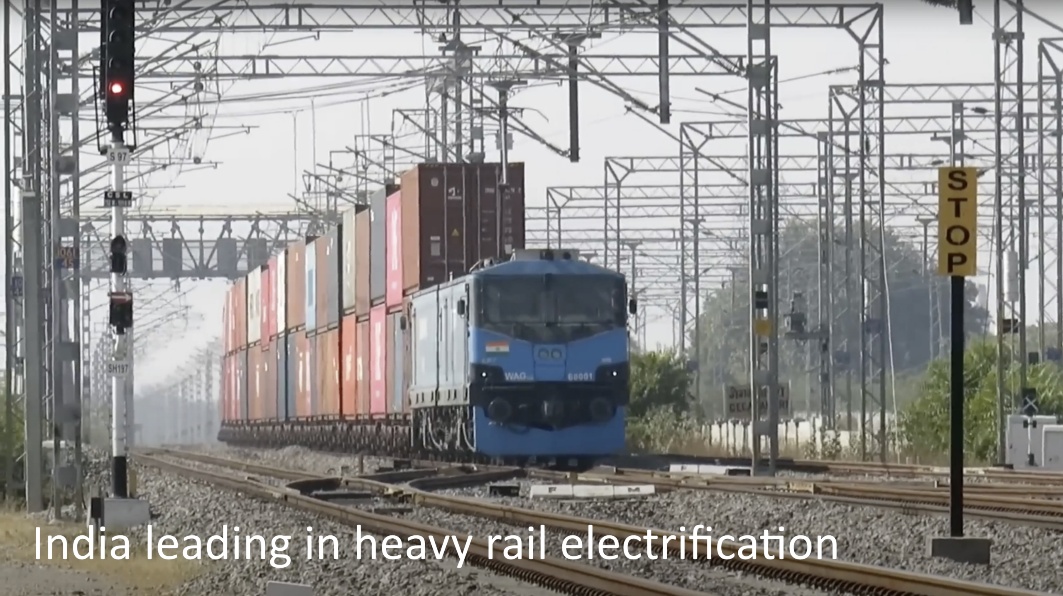
In the illustration “Pockets of the Future” we see electrified rail, electrified shipping, wind turbines, large utility solar installations with storage batteries, and small-scale solar installations on roof tops in the mix. Also included is a slide from his talk titled, “ India leading in heavy rail electrification. ”
This electrification process started about 15 years ago and now India with 1. 4 billion people moves 99.7% of its freight by rail.
Of course, we also have China. This country with a population of 1. 3 billion people and the world’s third largest economy, has a rail system where 80% of its freight is electrified and all 30,000 miles of its high-speed rail[passenger]is electrified.
And there is more.
Morocco’s high-speed rail is electrified. Japan’s high-speed rail is electrified. In Europe, about 60% or more of all rail is electrified. And we cannot forget Morocco with more high-speed electrified rail than all of North America.
And Mr. Barnard does not stop here. Bogota, Columbia, 15 years ago, had serious air pollution primarily from the combustion of fossil fuels. But, “ Now Bogotá has one of the largest electric bus fleets outside of China. There are about 1, 500 electric buses operating on the roads. That’sf ar more than Canada has operating or on order. And these are not small buses. They include triple-articulated buses, the largest type of mass transit bus in operation. They are battery electric. ”
The same wave is happening in Santiago, Chile and in Kenya where tens of thousands of electrical buses are on order. Across the developing world, countries “ are leapfrogging directly to battery electric buses. ”They are bypassing the fossil fuel era. See slide from author’stalk “Pockets of the Future” presentation titled “Battery electric buses in Bogota.”
China, of course, is the global leader. They have roughly 700, 000 electric buses. They electrified rapidly and at scale.
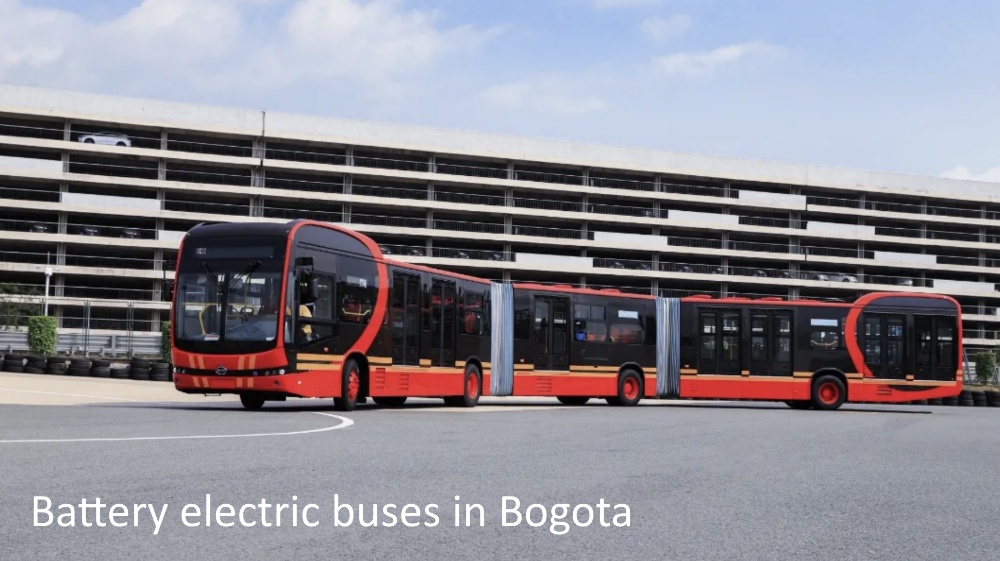
“Electric buses are a global pocket of the future. They work. They compete economically. People accept them. In fact, people prefer them. They are quiet, and they don’t pollute the air.”
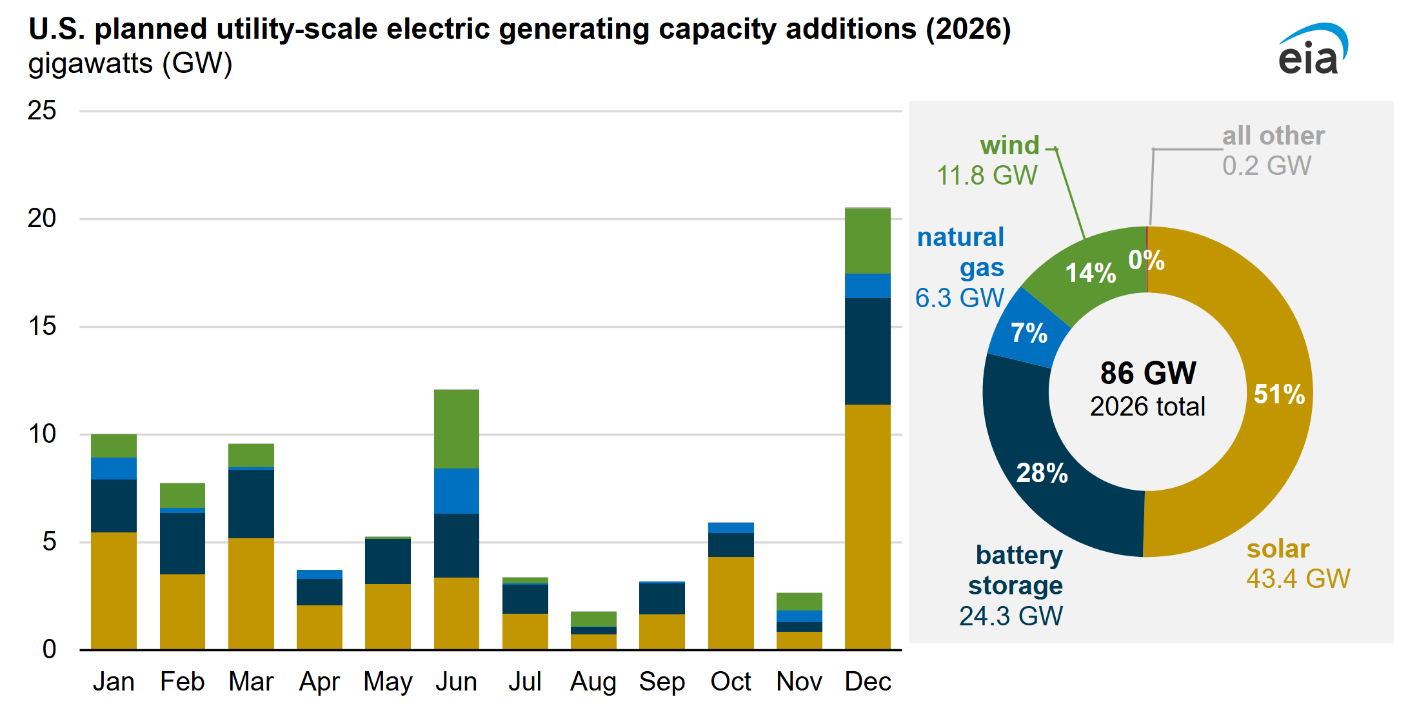
Even 2026 is looking good here in the U. S. in terms of renewable energy installations. See the vertical bar chart and circular diagram, titled “U. S. planned utility-scale electric generating capacity additions (2026).” Information is supplied by eia [Energy Information Agency]. The vertical bars show the anticipated installations for each month of the year. Overall, of the 86 gigawatts [GW] 51% will be solar, 28. 5 % will be battery storage, 11. 8% wind, and only 7% is natural gas. That is a lot of renewable power!
It will take environmental groups, legal/ lawsuits, and lots of advocacy to get this plan over the finish line but it looks promising.
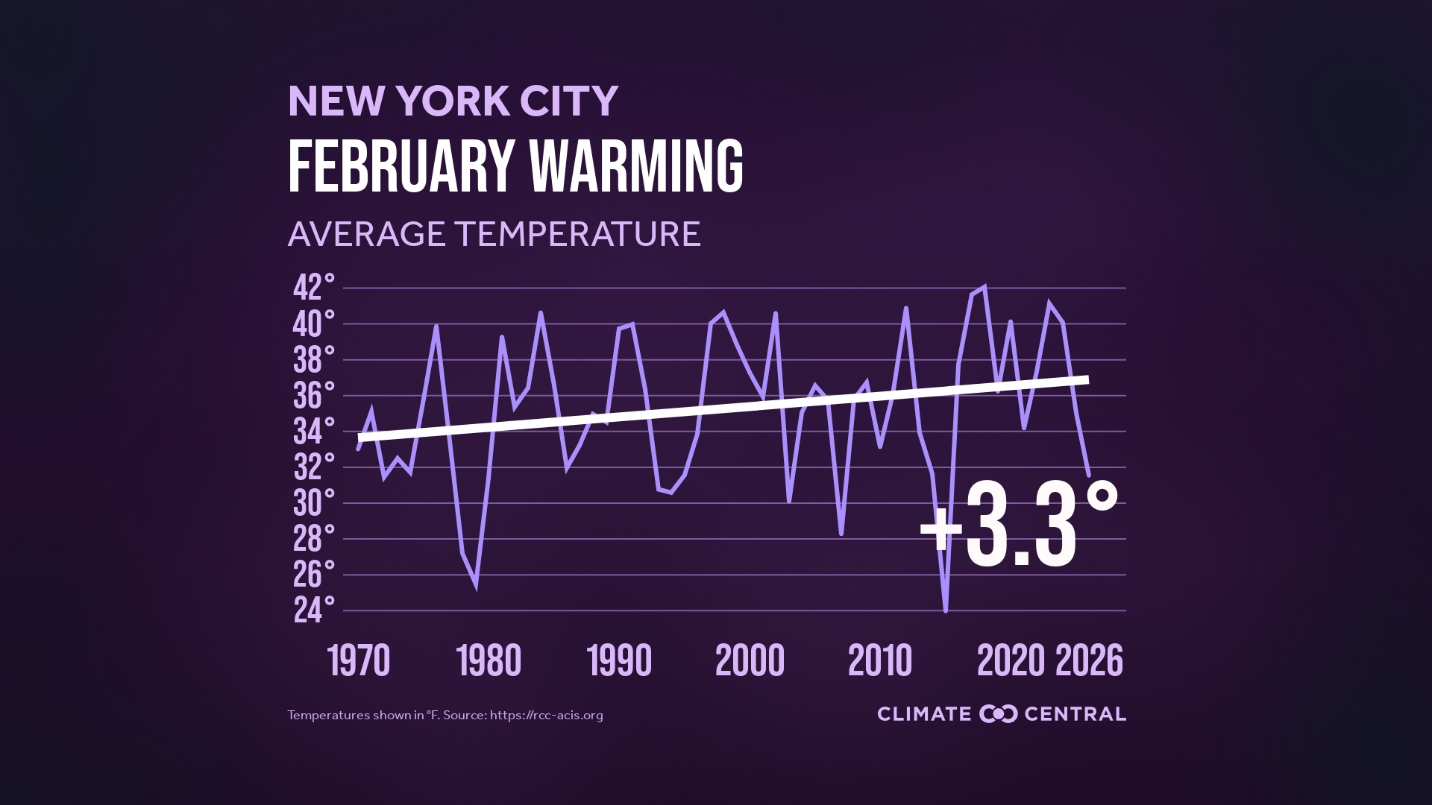
Meanwhile the planet continues to respond to our inputs of carbon dioxide into the atmosphere. See the 50+ year graphic from Climate Central titled New York City, February Warming.
Bits and pieces, flotsam and jetsam, or this and that.
*Nature magazine reports that the U. S. has withdrawn from 66 scientific, cultural, farming, health and security organizations [United Nations and international], many of which it helped to create.[Nature, vol 649, 29 January 2026].
*The only U. S. ice breaker supporting scientific research in Antarctica was decommissioned in 2025 and plans for a replacement were shelved. For this research season many American scientists had to hitch a ride on the Araon, an icebreaker from the Korea Polar Research Institute. [The New York Times, March 3, 2026, D 8].
*More than 10, 000 Ph. D. employees in federal government were fired or chose to leave in 2025. [Science, p 751, 19 February 2026].
*U. S. energy storage[batteries]along with renewables, shatter ed records in 2025 with 58 GWh installed. This was 30% more than in 2024. [pv magazine USA, 23 February 2026].
*In January 2026, a total of seven gas-powered cars were sold in all of Norway.[Newsletter, David Wallace-Wells Feb. 25, 2026].
Changes are happening.
And so it goes.
The scientific career of Raymond N. Johnson, Ph.D., spanned 30 years in research and development as an organic/analytical chemist. He is currently founder and director of the Institute of Climate Studies USA (www.ICSUSA.org). Climate Science is published monthly.