

Great Britain [GB], the place where the industrial revolution began in the late 1700’s, when coal provided power for trains, new factories making all kinds of energy intensive products and more, has set a record.
Through September this year, GB has run on 100% clean energy [electrical power] for a record 87 hours. That is only about 2½ days total, but it is increasing rapidly and moving towards its clean-power target for 2030. According to the website, “resilience” and data from “Carbon Brief,” it was just 2.5 hours in 2021 and 64.5 hours in all of 2024 .
This 2030 goal for 95% clean power includes no more than 5% coming from gas. While GB has a long, long way to go, it is the world’s sixth largest economy [GDP] and sets an example of what government policies can strive to make possible. About 66% of the electricity generation has come from nuclear, solar and wind supplemented by imports of green electrical energy coming from Europe. The plan is to have GB’s power needs, eventually, to come from only domestic sources. Lots of numbers here but a powerful story.
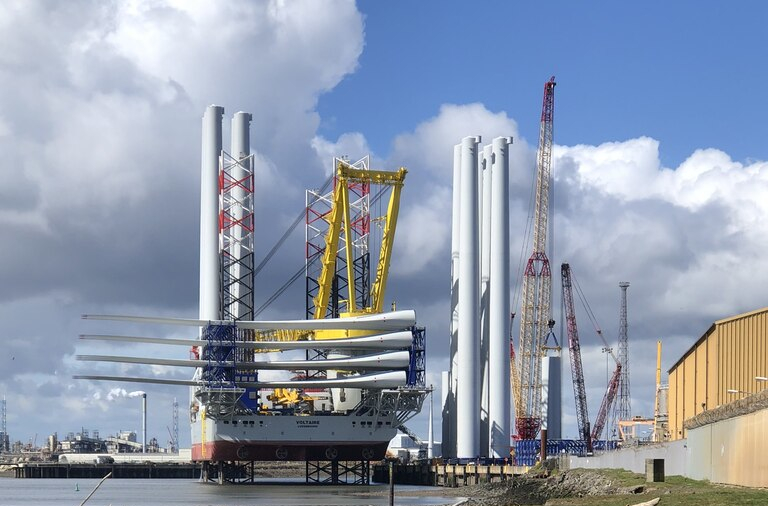
Photo by David Robinson is of Able Seaton Port in GB which is the hub for construction of 277 giant wind turbines targeted for the Dogger Bank Wind Farm in the North Sea. Note the large turbine blades lying horizontally on the ships deck, and the tall cylinders that will be used to support the turbine from the seabed.
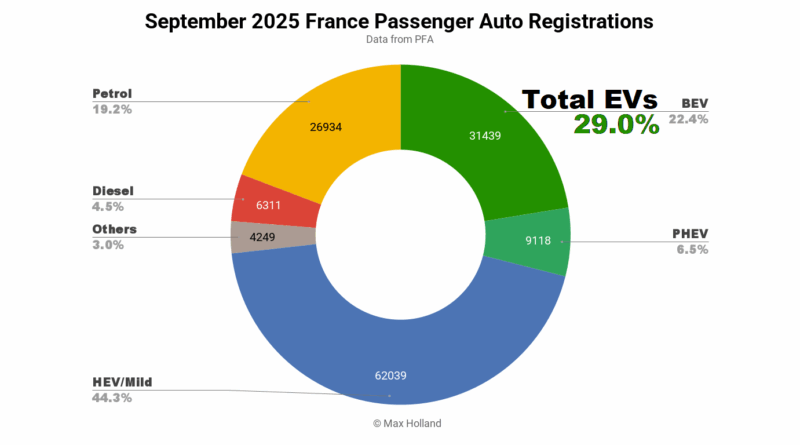
France is also in the news. Of some 140,000 new car registrations in September 2025, about 40,000 were electric vehicles [EVs] [2]. Full battery cars [BEV] were 24% of the total while plug-in hybrids [PHEV] were at 6.8% of the total. See the circular graph by Max Holland of Clean Technica. In that same graph over 62,000 autos or 44.3% were HEV’s [Hybrid Electric Vehicles]. These cars do not require external charging but use regenerative braking and the gasoline engine itself to charge the battery.
And we can’t ignore what the Norwegians are up to either.
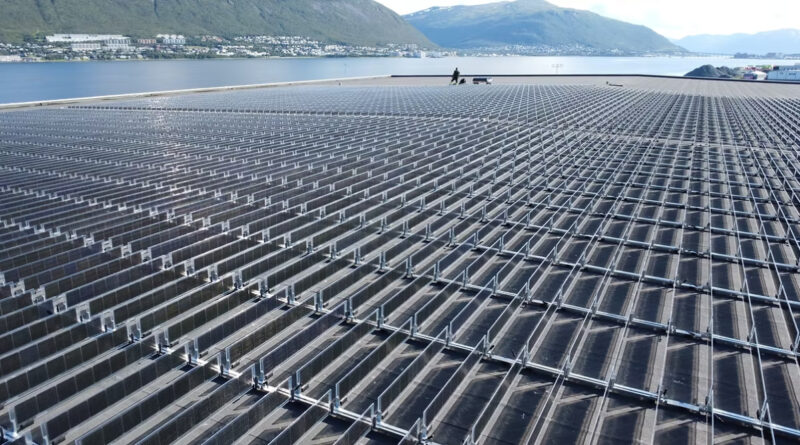
Tromso is a city far north of the Arctic circle which means the sun is low in the sky most of the year and even below the horizon for some days. One might think that this would not be a suitable location for photovoltaics or solar panels, but they thought differently. Their project, called Tromsoterminalen, has the world’s largest installation of vertically mounted bifacial solar panels. These bifacial vertically mounted panels catch the sun’s rays, which are very low in the sky this far north, from dawn to dusk.
According to Over Easy Solar, an Oslo based company, an angled or tilted array has some disadvantages including high snow load which will reduce efficiency and have high wind exposure. “Vertical photovoltaics [VPV] is the future of flat roof solar in extreme weather regions”. This concept was “developed in Norway with the challenges of northern Europe’s climate in mind and performs exceptionally well”.
See photo, courtesy of Over Easy Solar, of this vertical solar installation.
Meanwhile, carbon dioxide continues to collect in our atmosphere and do what the physics says it will do: capture infrared radiation normally radiated into space and return some of it to Earth’s surface. Our combustion of fossil fuels continues on a huge scale.
On September 17 Berkeley Earth posted the “August 2025 Temperature Update”. See the rising curve in the graph titled “Berkeley Earth – Global – August.”
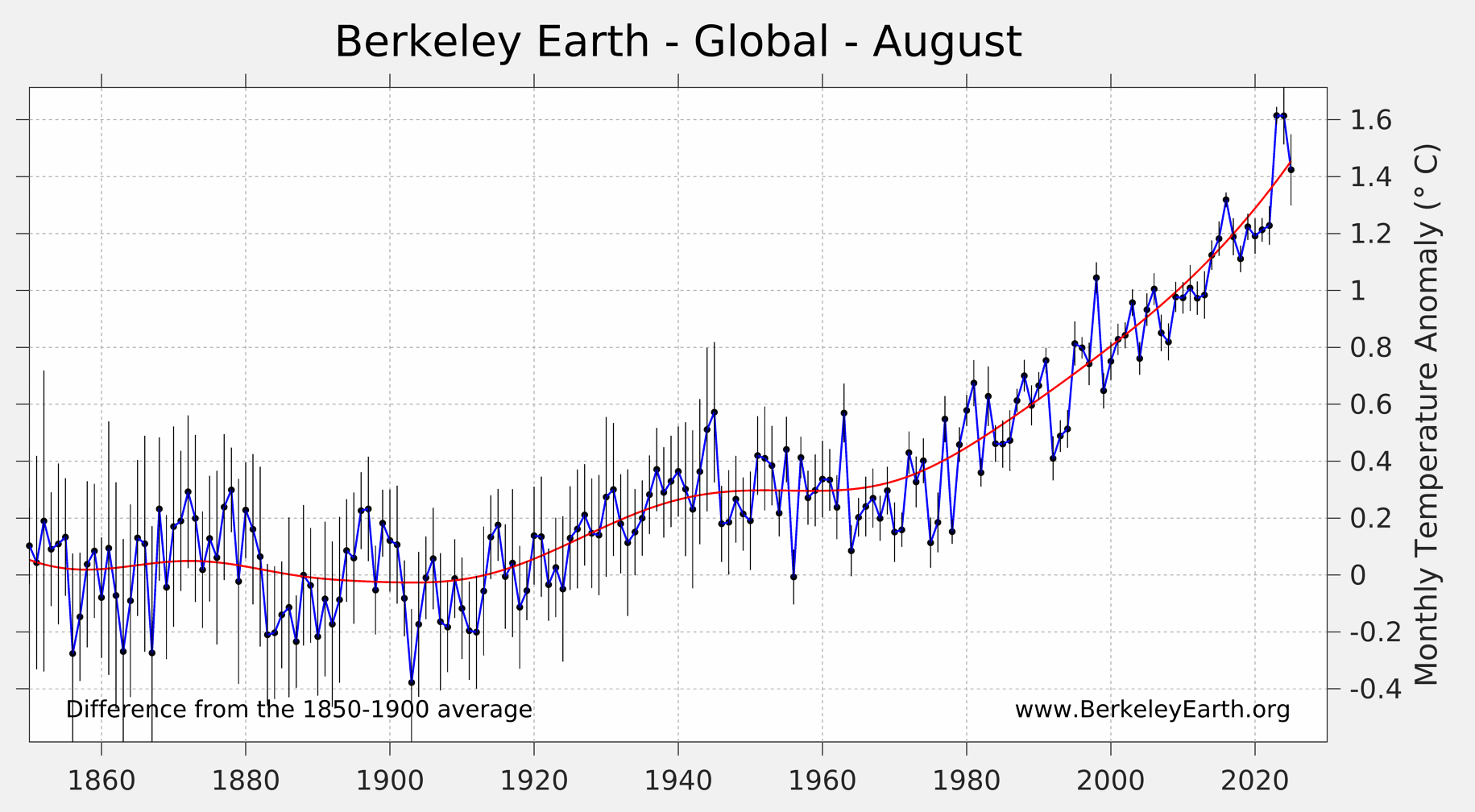
There is just no denying it; our planet is warming, and the rate of warming is increasing. August was the third warmest August in the 175-year temperature record behind 2023 and 2024. There is a 95% likelihood that 2025 will be the third warmest year on record.
And heat kills! See the horizontal bar chart labeled, “Excess deaths from the European Heatwave.”This chart was obtained from the Independent newspaper in England. This data and the death estimates come from a new field called “attribution analysis.”
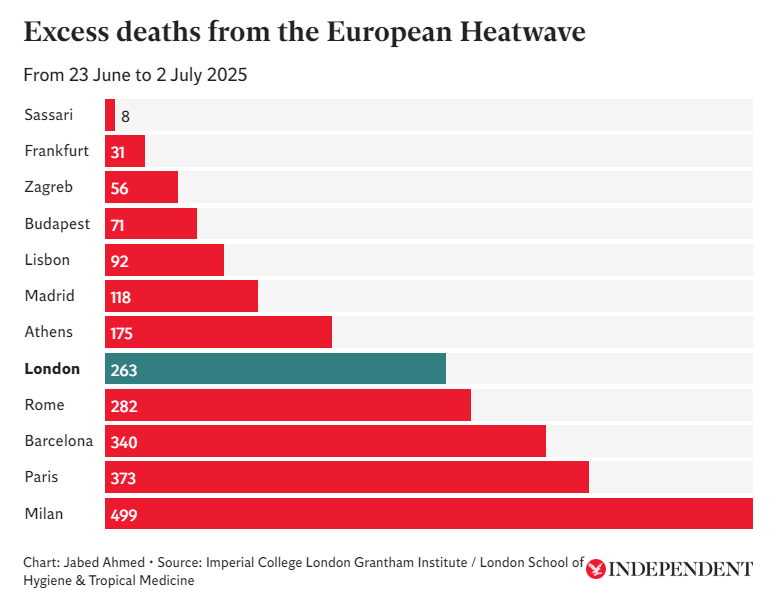
Scientists and statisticians look at deaths on the same date in the past number of years and also the temperatures on those dates; from that and more they can estimate the excess deaths caused by the current heat wave. And, these are the estimates just for selected cities in Europe. Worldwide the total would be far larger.
And then we must recognize the passing of a special scientist and person.
Dr. Jane Goodall passed away on October 1, 2025, at the age of 91. She left behind a legacy of conservation and research with chimpanzees that opened “the way people see, think about and engage with primates – including human primates.” [Today’s Climate, 10/7/2025].
She was on a speaking tour and giving up to 300 talks a year on conservation and the theme that “we are part of Mother Nature.”She was interviewed in March this year by Brad Falchuk of Netflix, for a series “Famous Last Words,” and left behind her last words that were only to be released after her death. Brad left the stage so she could talk directly to the camera and give her final, unedited thoughts. They are available on Netflix and are a moving tribute to a remarkable woman.

She also stated, “you have it in your power to make a difference. Don’t give up.”
And, so it goes.
The scientific career of Raymond N. Johnson, Ph.D., spanned 30 years in research and development as an organic/analytical chemist. He is currently founder and director of the Institute of Climate Studies USA (www.ICSUSA.org). Climate Science is published monthly.
Sources
- Today's Climate, 7 October 2025
- Over Easy Solar
- Hybrid Electric Vehicles