

We All Love Records of Some Sort: But Newer Climate Ones Are Not So Good
Some of us may remember when Roger Bannister broke the 4-minute time record for running a mile. At the time it did not seem possible for a human to run that fast. He competed in the 1952 Olympics in Helsinki, did very well, and then set his sights on running a mile in under 4 minutes. He accomplished this feat on May 6, 1954, in Oxford with a time of 3 minutes and 59.4 seconds. His “landmark run ranked number 13 in the list of the 100 Greatest Sporting Moments”. [Wikipedia].
We are all aware of records in skiing, basketball, ice hockey, baseball strikeouts, and a lot more. However, we are setting records today in Earth’s climate that are of a different sort and are dangerous to our health and Earth’s biosystems.
See the two-part image, titled, “Western Europe experienced its warmest summer on record,” courtesy of Inside Climate News, by Bob Berwyn, September 30, 2026.
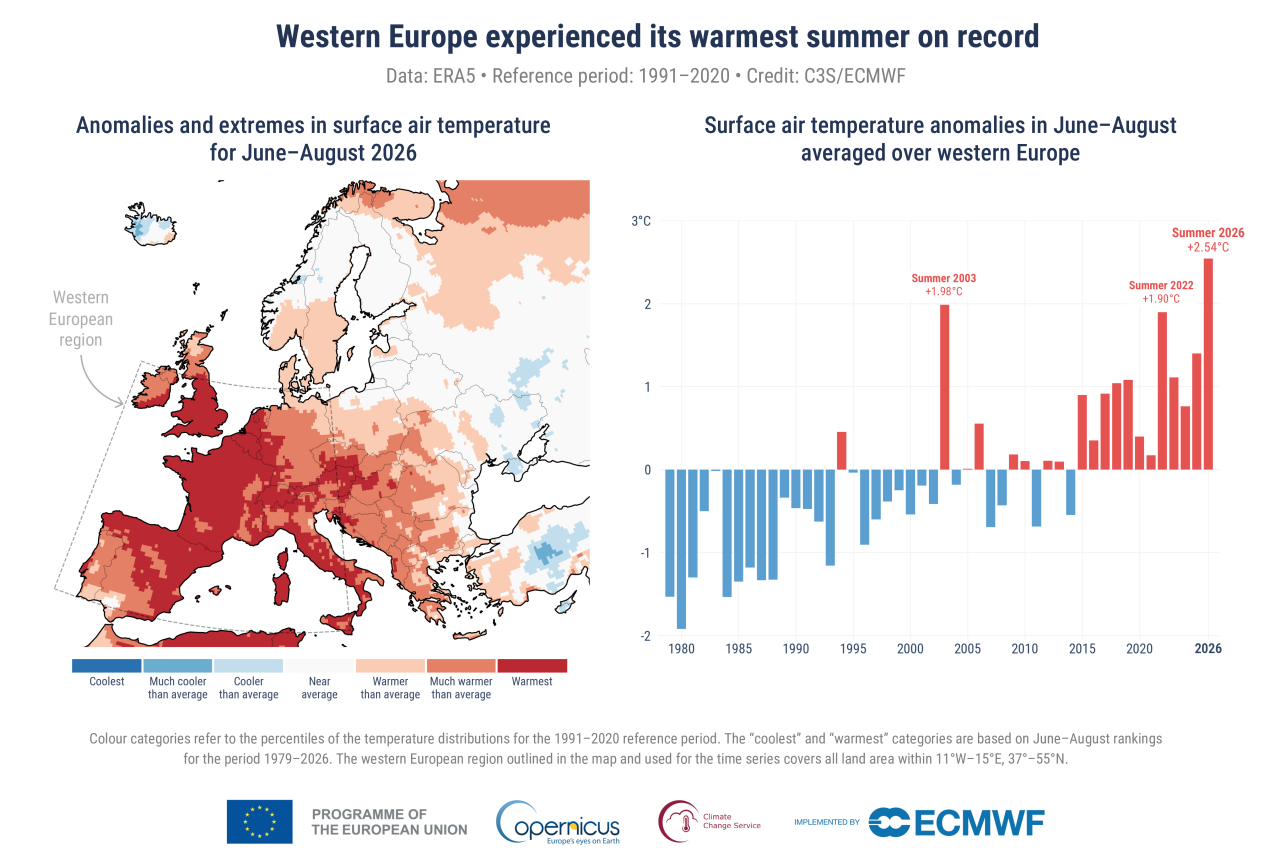
The data come from a variety of sources in the European Union including Copernicus, its climate science agency [note information sources at bottom of image.]. The left portion of the image is a map of Europe including the UK on the left, Scandinavia at the top, eastern Europe with Turkey and the Black Sea on the right. The very dark colors in the borders of Spain, France, Italy, Germany and more tell a story of a record-breaking heat wave. Indeed, the summer of 2026 was the hottest on record. See the dashed lines for the boundary of western Europe.
The right-hand image of that pair shows the surface air temperature anomalies. All the data is averaged and set to zero degrees. Each year is then measured relative to that average. The early years are all cooler and the later years are all warmer than that average. In the 45-year dataset, the last 12 years have been much warmer than usual as seen by the vertical bars above the zero line. Note that 2003 was also an unusually warm year.
And it is more than just heat. Most of the homes, businesses, stores, and infrastructure in Europe were built in the past for a different climate that does not exist today. It was cooler, and air conditioning was seldom installed. The preliminary estimates are that some 40,000, or more, people died of heat-related deaths in the four-month period from May through August this year. This heat has the biggest impact on the elderly and those with other health related issues.
And, we have another climate record. Let us not forget Earth’s oceans which cover about 75% of our planet’s surface. The extra heat in the atmosphere caused by the increasing levels of greenhouse gases is absorbed to a large extent [about 90%] in the oceans.
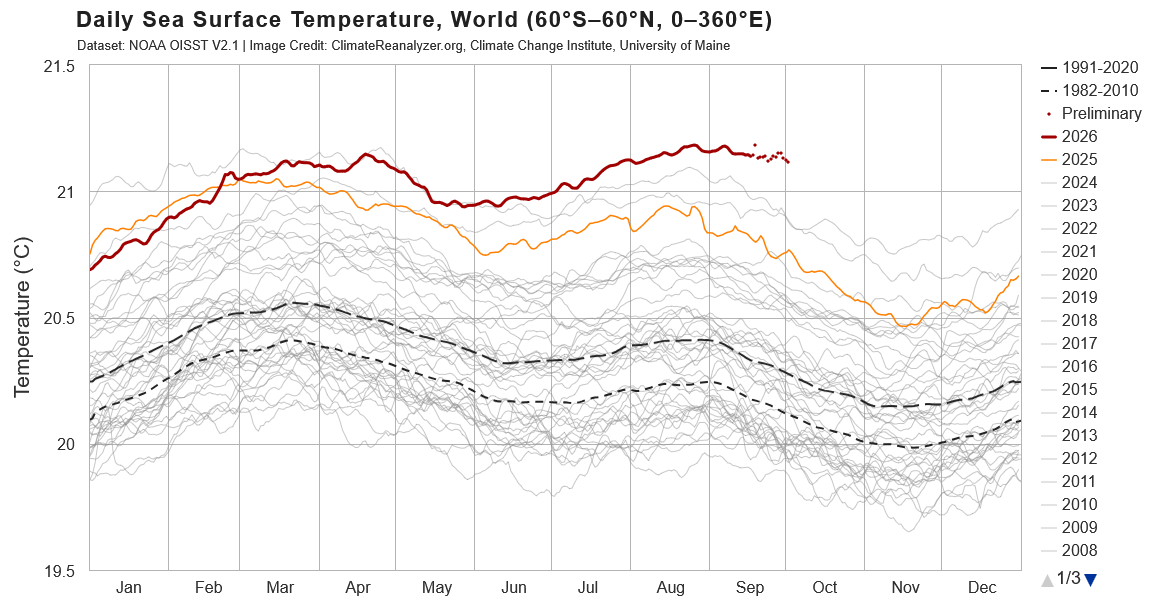
See the dataset from NOAA [National Oceanographic and Atmospheric Administration], and presented in the graph by Climatereanalyzer titled “Daily Sea Surface Temperature, World…” The left axis is Temperature and the bottom, or horizontal axis, is months of the year. The data for 2026 is through September. The top bold/solid line is for 2026 and clearly shows the record heat in the oceans. It is astonishing and the impact on global ecosystems including the Arctic and Antarctic is just beginning to be felt.
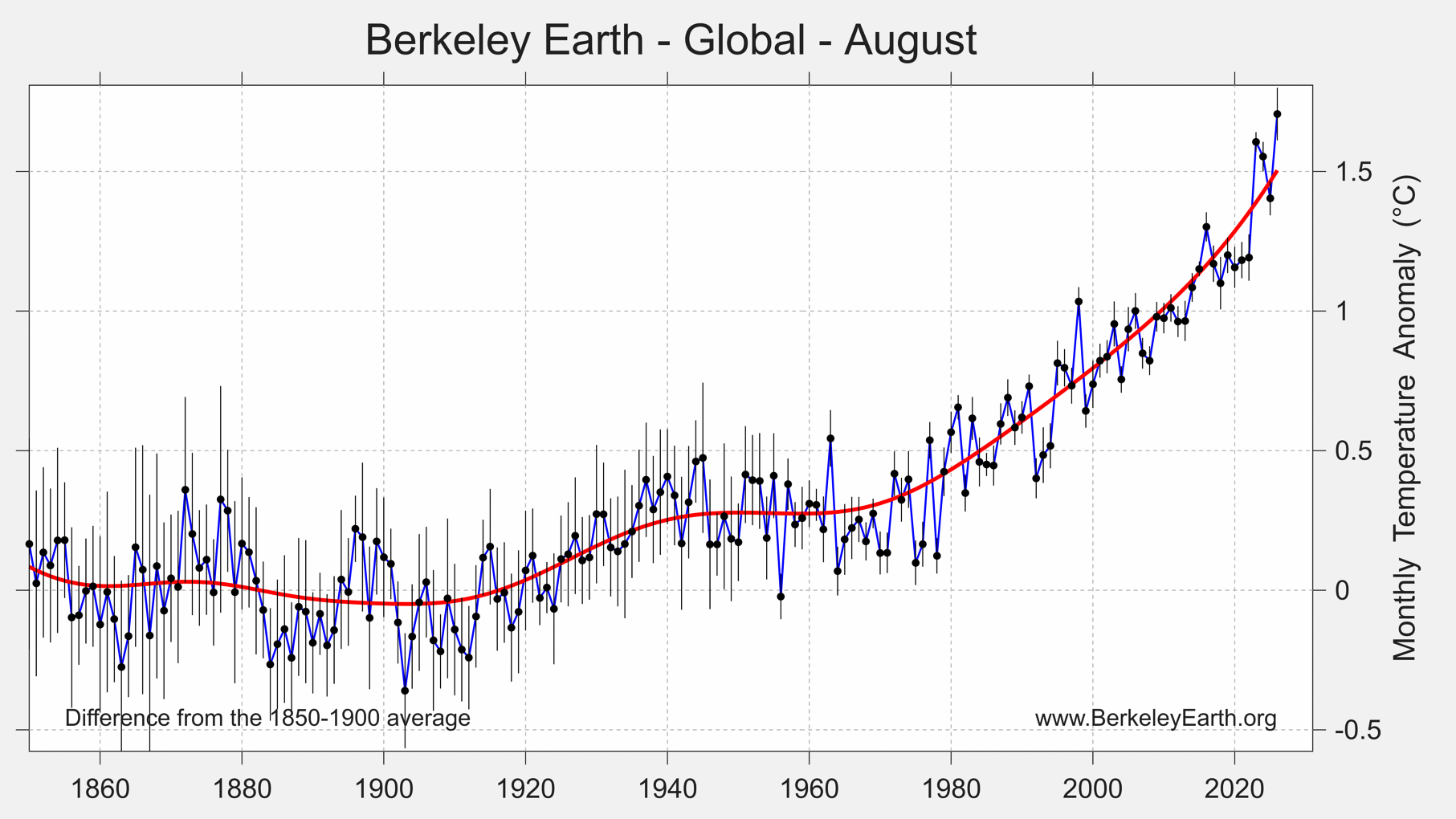
And then we have another record. While western Europe had a record temperature for its summer, we see that the whole planet also broke the atmosphere temperature record for August 2026 by a significant margin. Hmmm, high temperature records for western Europe, record ocean temperatures, and record air temperatures globally for August strongly support that climate change is happening and that our home planet is heating up.
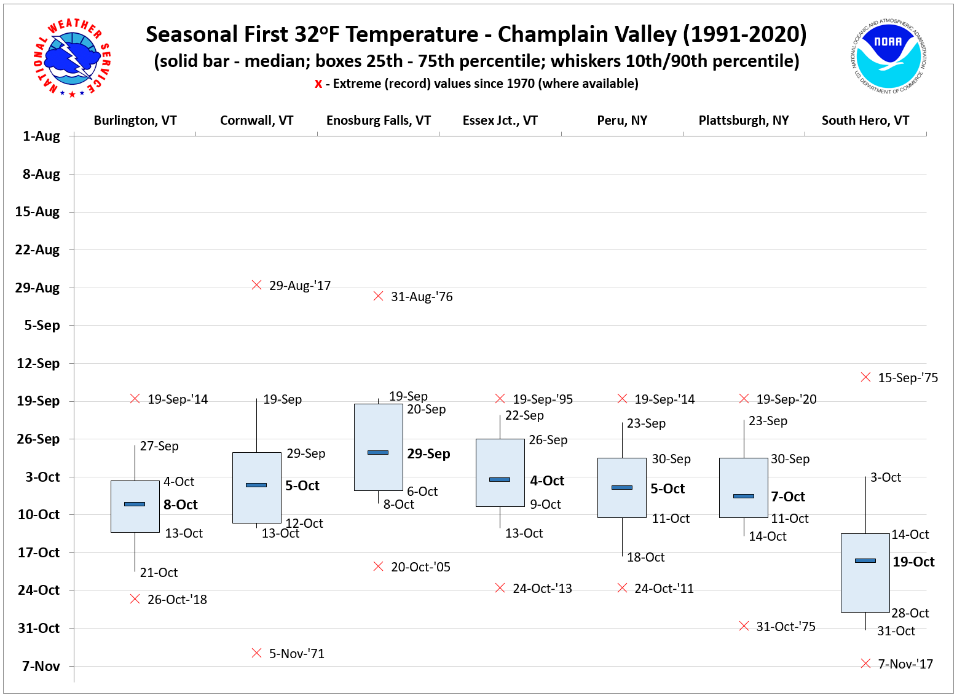
And closer to our home we have recent 30-year data from NOAA showing the first frost dates in our region. See image titled “Seasonal First 32F Temperature – Champlain Valley.” The small horizontal bar in each box is the median date for a first frost. A similar chart from decades ago would have shown much earlier first frost dates.
This and That
***Medieval wine tasting records fill in gaps about Europe’s climate back to the 1400’s. Science Vol.385, July19, 2026].
***Electric buses make up over 50% of new deliveries in Australia. [CleanTechnica July 4, 2026.]
***A landmark MIT study debunks persistent myths about electric vehicles … and that EV’s cost no more to own than a comparable gas car almost anywhere in the U.S. [The Daily Climate May 27, 2026.]
***” Utah produced more power from solar than any other source in May,” … “and experts expect the trend to continue despite cuts to federal clean energy incentives.” [The Salt Lake Tribune, August 3, 2026.]
***” In July, a wildfire threatened a European capital city – Madrid. More than 100,000 people were evacuated and over 400,000 acres have burnt across Spain” more than five times normal. [Nature Vol 656, 20 August 2026.]
***” There is now enough solar power installed in the United States to power approximately one-third the homes in the nation. There’s enough capacity installed to power around 50 million US homes.” [CleanTechnica 9/10/2026.]
***Uruguay’s adoption of EV’s surprises many and EV sales have exploded going from 5% to 50% battery EV market share in only 2 ½ years.
And, so it goes.
The scientific career of Raymond N. Johnson, Ph.D., spanned 30 years in research and development as an organic/analytical chemist. He is currently founder and director of the Institute of Climate Studies USA (www.ICSUSA.org). Climate Science is published monthly.
Sources
- National Oceanographic and Atmospheric Administration
- CleanTechnica, 4 July 2026
- The Daily Climate, 27 May 2026
- The Salt Lake Tribune, 3 August 2026
- Nature, 20 August 2026 (Vol 656)
- CleanTechnica, 10 September 2026