

People, businesses, and nations always have had to deal with change. And change is hard and frequently, messy. Over a century ago we had a major transition, and this was a technological one; and it was challenging and difficult for many.
Note the photo here from 1900 of 5th avenue in New York City [Credit: Wikipedia]. The caption stated that there is apparently one car visible amidst all the horse drawn carriages. It is estimated that there were over 100,000 horses in the city at that time. Just consider the ramifications of this.
Those horses had to be fed, housed, cared for and mountains of manure to be dealt with. There were wheelwrights, veterinarians, farmers growing hay and grains, carriage repair businesses, farriers and many more people and businesses involved in this transportation system. Because real estate in the midtown was so valuable, there were even horse elevators to “park” the horses underground when not needed.
However, ten or so years later photos show horses had all but disappeared from the city. They still were used for transportation in rural areas, but even here they were largely replaced in the early ‘20s.

It is hard to comprehend all the changes required to bring this transition about and there had to be a lot of winners and losers in this transition. But it happened. It just made sense.
Today, globally, in a similar way we are faced with another huge transition. This is the move away from fossil fuels to renewable sources of energy such as solar, wind, geothermal, biomass, tidal and so on.
These renewable sources are, in almost all global markets, cheaper sources of electricity, and healthier for people and the planet. They produce far fewer air particulates with the attendant health benefits, less emissions of the neurotoxin mercury, and less carbon dioxide, methane, and nitrous oxide pollution.
An additional recent factor in the current transition is energy security; one does not have to worry about getting sunlight or wind through the Strait of Hormuz.
However, there are strong forces at work to preserve the status quo: money, politics and business. Fossil fuel drilling, digging, extraction, fractionation, and transportation are all businesses determined to resist this transition. And this administration is OK with this and actively works to prop up the “old”.
But this transition is happening anyway. Energy security, health benefits, low cost, and simple infrastructure are holding sway, not to mention the benefits to our atmosphere and planet.
And this transition is happening with remarkable speed.
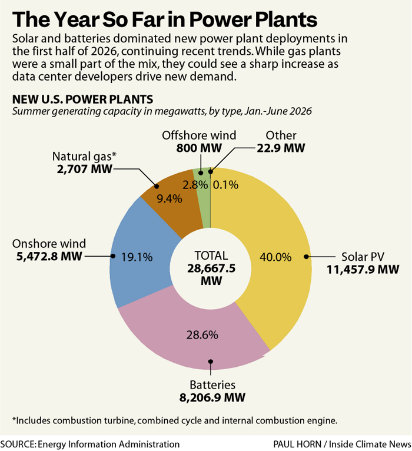
Let’s look at the chart labeled, “The Year So Far in Power Plants”. The data are from the U.S. Energy Information Administration and compiled by Paul Horn of Inside Climate News. This circular chart has a lot of information in it.
The center of the circle indicates that 28,667.5 megawatts [MW] of power were deployed in the U.S. in the first 6 months of 2026. Solar PV, Batteries, Onshore wind, Offshore wind make up 90% of the total. About 10% of the total comes from natural gas. This is an enormous amount of renewable power.
While this growth in renewables is powerful, this increase in power generation may still not be sufficient to meet the growing needs of Artificial Intelligence [A.I.] computing, data centers, more air conditioning to blunt the impact of extreme heat waves and so on. This whole area of growth is still being assessed with many decisions still to be made.
There is no guarantee that this momentum will be maintained and grow, and global issues will, to some extent, influence what happens next.
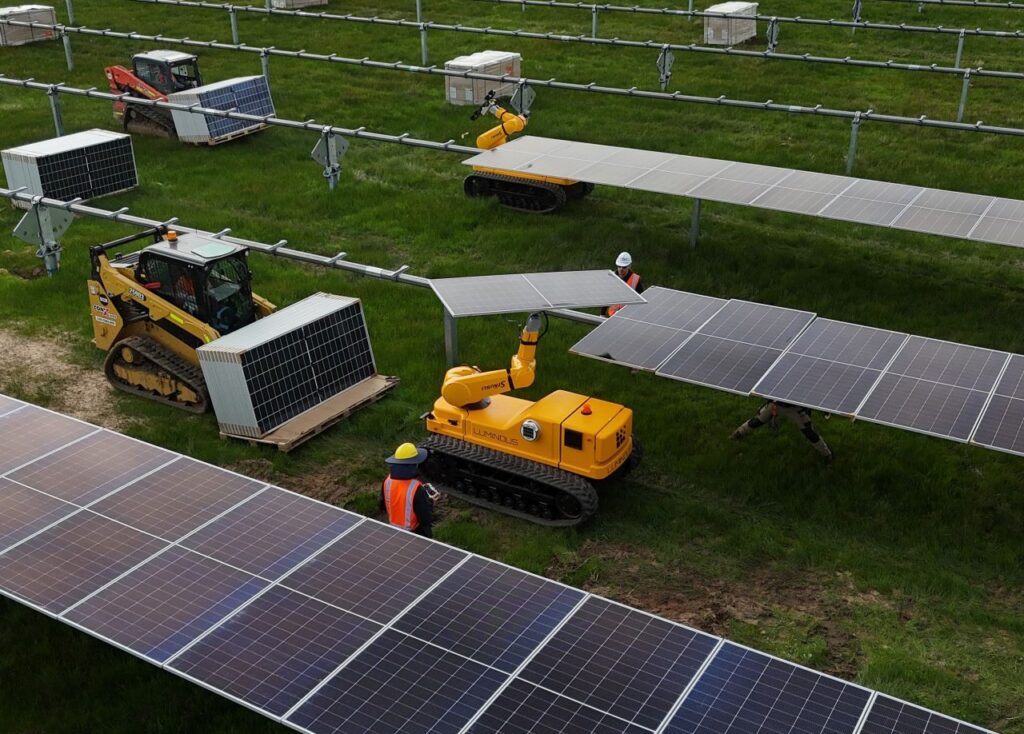
As automation and robots are developed prices for solar energy generated electricity will continue to drop. See photo [Luminous testing its LUMI S4 fleet during construction of the Goorambat East Solar Farm | Image: Engie Australia] of an installation of solar panels being assembled and installed. Note the robots carrying and deploying solar panels.
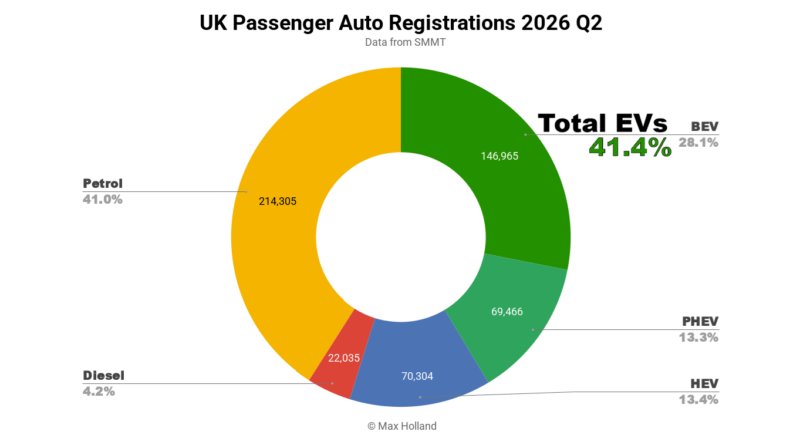
Technology changes are happening elsewhere too. Take for example electric vehicles [EV’s]. Another circular graph titled “UK Passenger Auto Registrations 2026 Q2 is presented here. [Clean Technica 7/24/26]. The transition from gas/diesel vehicles to EV’s is speeding up. Full battery EV’s [BEV], and plug-in hybrid EV’s [PHEV] now account for over 41% of UK passenger registrations in that 3-month period.
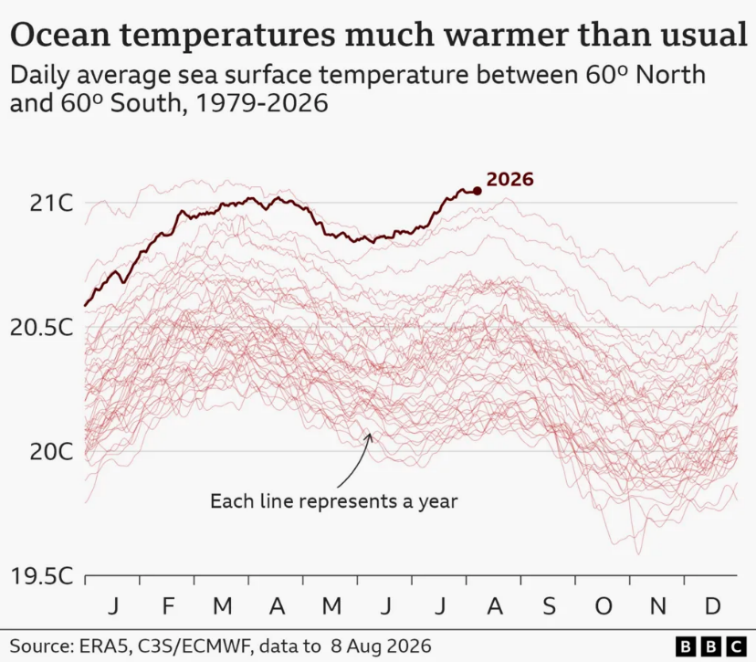
And all this work and advances in renewable energy are coming at an important time in Earth’s climate and weather systems. Note the graph titled, “Ocean temperatures much warmer than usual.” The data come from the ECMWF Reanalysis v5 (specifically, the fifth-generation European Centre for Medium-Range Weather Forecasts atmospheric reanalysis of the global climate).
The spaghetti-like lines in the lower portion of the graph are all 47 years in the dataset. The new dark line at the very top represents 2026 to date. This elevated and record-breaking ocean temperature, along with an on-coming el Nino, together may reinforce extreme weather events in later 2026 and 2027 that will occur. Stay tuned.
Now we have some “Facts of Interest.” [daily, NYTimes].
*A new word has entered the language, ‘solastalgia’. First used by The Lancet journal in 2015, it is “a word related to nostalgia, which describes the emotional strain of witnessing one’s environment change or deteriorate”. [Nature, Vol 654, 25 June 2026].
*Over 250,000 public EV chargers operating in the U.S. now. [Clean Technica 6/16/26].
*” Hottest June day ever as UK heatwave smashes temperature records.” [Independent, Bulletin, 24 June 2026.]
*Another milestone in photovoltaic energy is that “the world has surpassed 3 terawatts [TW] of installed solar capacity.” [PV Magazine USA 8/17/26].
*According to Bloomberg NEF [New Energy Finance] it “took about 10 years for global solar capacity to rise from 100 GW in 2012 to 1 TW. The second terawatt was added in less than 3 years, while the third came less than two years later.” [PV Magazine USA 8/17/26].
*” Solar and wind each produced more electricity than coal in USA in April.” [Clean Technica 6/27/26].
* “In the second half of 2026, a whopping 156 new electric vehicle models are expected to hit the Chinese auto market.” [Clean Technica 7/14/26].
And so it goes….
The scientific career of Raymond N. Johnson, Ph.D., spanned 30 years in research and development as an organic/analytical chemist. He is currently founder and director of the Institute of Climate Studies USA (www.ICSUSA.org). Climate Science is published monthly.
Sources
- Clean Technica, 24 July 2026
- NYTimes
- Nature, 25 June 2026 (Vol 654): Oceans in Asia smash heat records — what it means for extreme weather
- Clean Technica, 16 June 2026
- Independent, 24 June 2026 — Bulletin
- PV Magazine USA, 17 August 2026
- Clean Technica, 27 June 2026: Solar & Wind Each Produced More Electricity Than Coal In USA In April
- Clean Technica, 14 July 2026: China About To Get 156 New Electric Vehicle Models!
- U.S. Energy Information Administration
- ECMWF Reanalysis
- Bloomberg NEF
- Luminous testing its LUMI S4 fleet during construction of the Goorambat East Solar Farm | Image: Engie Australia
- New Energy Finance